Tree Removal in Dublin, OH
Safe, clean removal of large, dead, and hazardous trees — handled by a licensed, insured crew that protects your property every step of the way.
Expert Tree Removal for Dublin Homeowners
Dublin’s established neighborhoods are full of mature oaks, maples, and ash — beautiful, but when one dies, gets storm-damaged, or outgrows its space, it becomes a real risk to your home and family. Dublin Tree Pros removes trees of any size safely and efficiently, from a single dead pine in the backyard to a towering hardwood leaning over your roof.
Every removal starts with a free on-site assessment. We evaluate the tree’s condition, lean, and surroundings, then give you a clear written quote with no pressure and no hidden fees. When you approve, our crew rigs and removes the tree in controlled sections — never just dropping it — and cleans up completely before we leave.
When You Should Remove a Tree
- Dead or dying trees — brittle limbs and weak trunks that can fall without warning.
- Storm & wind damage — split trunks, hanging limbs, or trees uprooted by Ohio storms.
- Disease or pests — emerald ash borer and other infestations that spread to healthy trees.
- Too close to structures — roots threatening foundations or limbs over your roof and power lines.
- Construction & landscaping — clearing space for an addition, pool, or new layout.
How a Dublin Tree Removal Gets Scoped
Two trees of the same height can be very different jobs, and almost none of the difference is the tree. What decides the work is what sits underneath it and what the crew can get near it. Before quoting we look at the trunk diameter and the lean, the condition of the wood, where the weight actually is in the canopy, and then the part that usually sets the price: the target zone. A roof, a pool, a fence, a septic field, a power drop or a neighbor’s garage under the canopy all mean the tree comes down in small controlled pieces on ropes rather than in a few large ones.
Access is the other half. A back yard reachable only through a five-foot side gate is a different job from one with a driveway to the rear, because everything — the chipper, the loader, the wood — has to travel that route in both directions. On established Dublin lots this is frequently the single biggest cost driver, and it is the reason a quote over the phone is a guess. The assessment is free and it is where the real number comes from.
Removals on Dublin’s Established Lots
Dublin’s neighborhoods were largely built with their canopy kept, which is what makes them pleasant to live in and what makes removals here technical. In Muirfield Village and Tartan Fields the mature trees are frequently original to the development and stand between houses, over decks and along cart paths, with landscaping underneath that the owner does not want walked on. Historic Dublin adds genuinely tight frontage and street trees that may not be yours to remove at all. Ballantrae, Llewellyn Farms, Riverside, Wedgewood and Jerome Village each have their own mix of lot width, rear access and covenant rules.
The practical consequence is that the approval conversation and the access conversation often matter more than the cutting. Where a neighborhood has requirements about work hours, equipment routes, debris staging or replacement planting, we would rather know before scheduling than discover it with a crew on site. Tell us the neighborhood when you request the estimate.
The Trees That Come Out Most Around Dublin
Ash. Emerald ash borer has moved through central Ohio and the ash it kills do not stay safe to work for long — the wood goes brittle and a standing dead ash becomes a climbing hazard rather than a climbable tree. That is why a dead ash is usually a more expensive, more urgent removal than the same tree would have been two years earlier. Our guide on emerald ash borer in Dublin covers how to tell what stage yours is at.
Callery and Bradford pear. These were planted heavily in suburban developments and they fail structurally as they mature — the branch unions are weak and an established tree commonly splits down the middle in a storm. Ohio has since restricted their sale, and replacing one before it comes apart is a planned removal rather than an emergency. See Callery and Bradford pear removal.
Oak. Oaks are the trees most worth saving here, and timing matters on them: fresh wounds during the growing season are how oak wilt moves between trees, so non-urgent oak work belongs in the dormant season. Read oak wilt in central Ohio before scheduling an oak. If you are not yet certain the tree has to go, the signs a tree needs removal guide and a free assessment are the right order — we would rather tell you a tree is fine than remove it.
Rigging, Bucket and Crane Work
Straight felling — putting the whole tree on the ground in one piece — needs a drop zone as long as the tree is tall, and on a typical Dublin lot that space does not exist. Most removals here are climbed or worked from a bucket and taken down in sections, each piece lowered on rope rather than dropped, which is slower and is what keeps the load off the roof below it.
Some jobs go past what rigging can do safely: very large hardwoods directly over a structure, trees too decayed to climb, and removals where the only route out is up and over the house. That is crane-assisted removal, where sections are picked and flown clear instead of being lowered through the canopy. It costs more per day and frequently less per job, because a two-day rigging removal becomes a morning. We will tell you which category your tree is in when we look at it, and we do not put a crane on a job that does not need one.
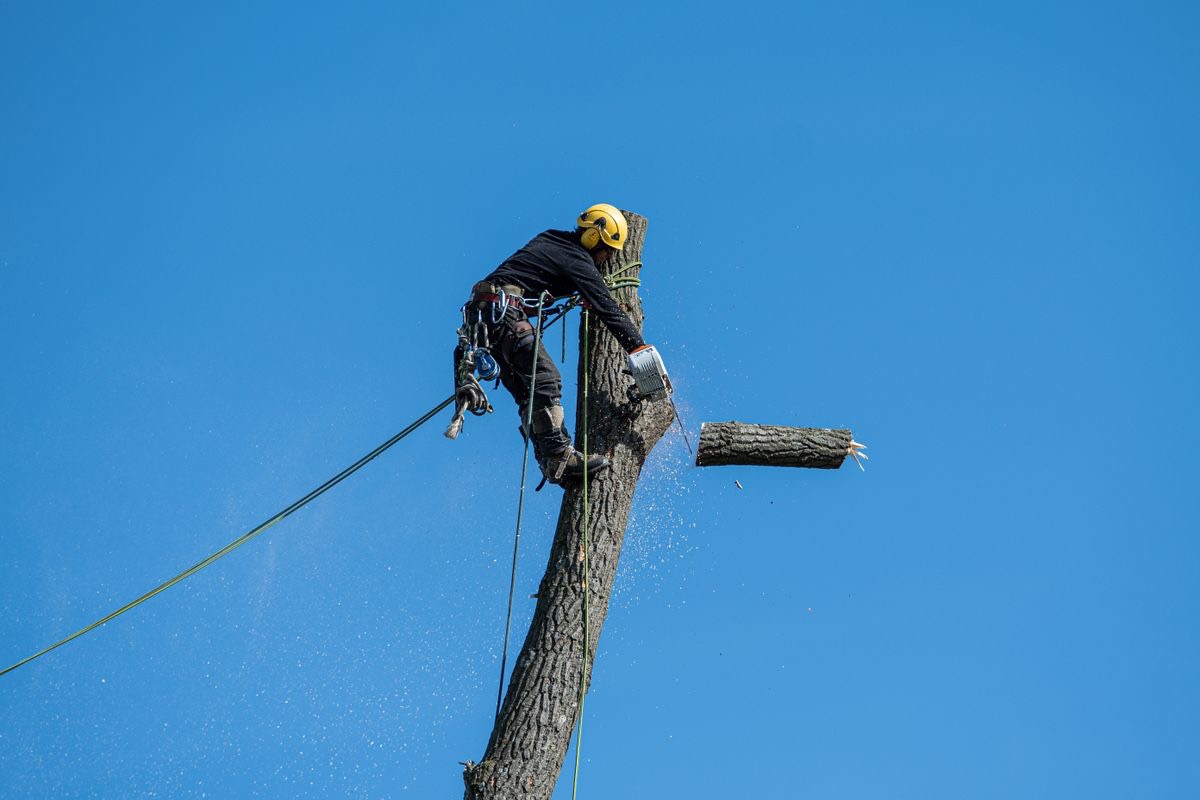
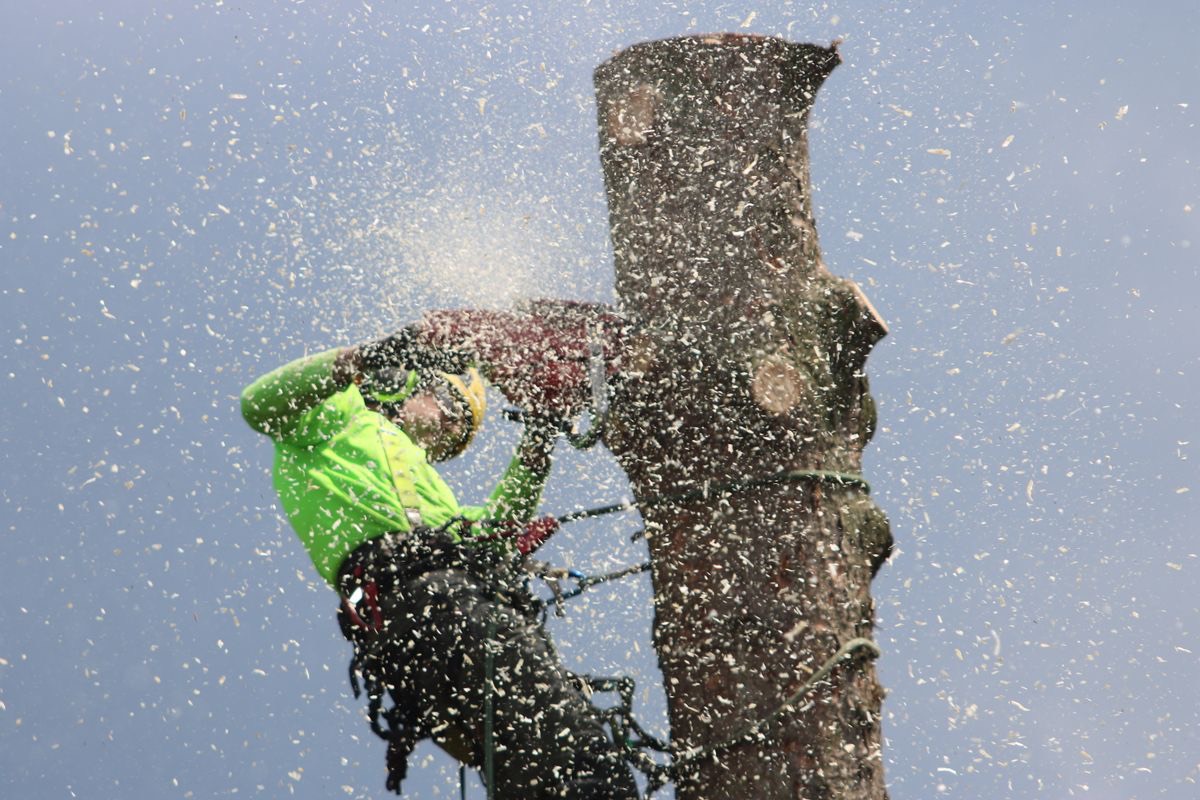
Example photos of the techniques described, not from a specific Dublin job.
Permits, Street Trees and Replacement Rules
Not every tree in Dublin is simply yours to remove. The city protects certain trees, the rules are not the same for a tree in your back yard as for one in the public right-of-way, and some removals trigger a replacement-planting requirement. Which of those applies depends on the specific tree and the specific address, so the honest answer to “do I need a permit” is that we confirm it before work starts rather than assume.
The detail lives in three guides: the Dublin tree removal permit guide, street trees and the right-of-way, and replacement tree requirements. If your tree is between the sidewalk and the curb, start with the right-of-way guide — that one is frequently the city’s tree rather than yours.
What Happens to the Wood, the Brush and the Stump
A standard removal takes the tree down to a low stump and hauls the wood and brush away, and the site is raked and blown clean before the crew leaves. If you want the trunk cut to firewood length and stacked instead of hauled, say so when you book — it is easy on the day and awkward afterward.
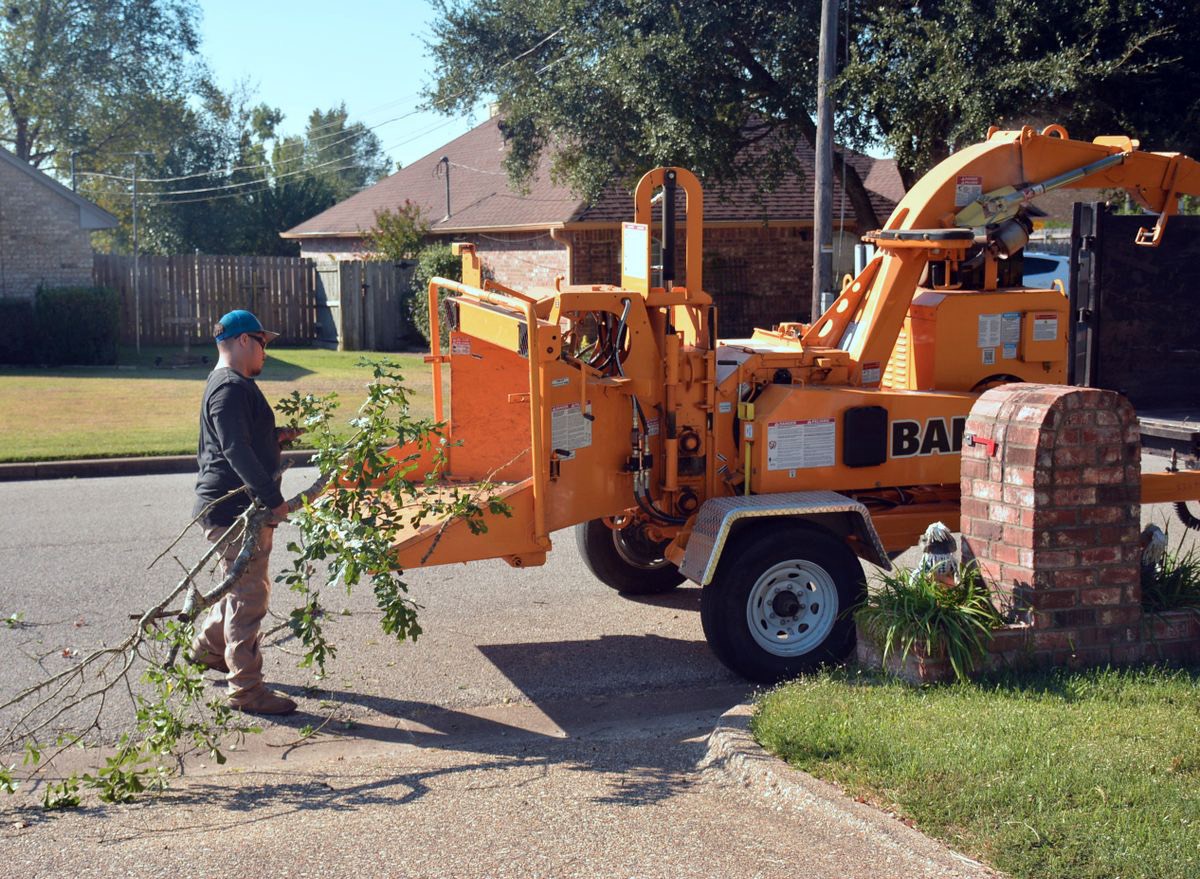
The stump is a separate decision. Grinding removes it below grade so the ground can be graded, seeded or planted over; stump grinding in Dublin covers what that involves, and stump grinding vs. removal explains when full removal is worth it instead. Homeowners handling their own cleanup after storm work should also see Dublin brush, chipper and yard waste. Planning the budget first? The Dublin tree removal cost guide breaks down what moves the number.
Licensed, Insured & Local Experts
We are fully licensed to operate in Ohio and carry comprehensive liability insurance. Proof of licensing and current insurance certificates are available on request — simply ask when we provide your free written estimate. Not sure what to look for in a tree company? Our guide on how to choose a tree service in Dublin walks through exactly what to verify before you hire.
The work is performed by experienced local professionals who specialize in tree care for established Central Ohio neighborhoods. We know the soils, weather, and tree-preservation rules across Dublin and surrounding communities.
Real results and reviews build trust. Request your free estimate and we’ll share recent before-and-after photos from comparable jobs in your area plus customer references. On-page Google reviews and job-site proof are priorities as we grow our local track record.
What to Check Before You Let Anyone Take a Tree Down
Removal is the one tree job that cannot be undone, and the one where somebody else's mistake can land on your homeowner's policy. Five things are worth confirming before the saws come out, and all five are verifiable before you sign rather than arguable afterward.
- A certificate of insurance sent directly by the agent — not a photocopy handed over at the door — naming both general liability and workers’ compensation. Without the second one, an injury in your yard can become your problem, and that is the single most expensive way to save money on a removal.
- ANSI Z133 is the written safety standard covering the work itself: climbing, rigging, and the minimum approach distances around energized conductors. It is the reason a trained crew declines some jobs near power lines and calls the utility instead of working the tree into a live service drop.
- ISA Certified Arborist certifies a person, earned by exam and kept current with continuing education, so it lapses if it is not maintained. The ISA publishes a public directory where a certification can be verified by name. Worth asking which individual holds it and whether they will actually be on site.
- A written scope that says what happens to the wood, the brush and the stump. “Haul away” means different things to different crews, and the stump is a separate decision with a separate price. Getting it in writing costs nothing and settles the argument that otherwise happens on the last afternoon.
- Who confirms whether the tree is regulated, and when. Certain trees are protected and the rules differ for anything in the public right-of-way. A crew that treats that as your problem to have researched is telling you how the rest of the job will go — our permit guide covers which trees are affected.
Every item on that list is checkable before work starts and nearly impossible to fix afterward, which is the whole reason to ask now. If you want the longer version, our guide on how to choose a tree service in Dublin walks through what to verify and what the answers should sound like.
Why Choose Dublin Tree Pros
We’re local to Dublin, fully licensed and insured, and experienced with exactly the kind of high-risk removals that mature suburban lots demand. That means zero liability for you, no damage to your property, and a yard left cleaner than we found it.
Planning ahead? Read our Dublin tree removal cost guide, check whether your job needs approval in our permit guide, or see the signs a tree needs removal. Wondering what happens to the stump afterward? Our stump grinding vs. removal guide covers it.
Already a tree-down emergency (on a structure, blocking your exit, or under dangerous tension)? Skip the schedule and use our 24/7 emergency tree removal in Dublin — we prioritize those calls over routine removals.
Tree Removal Questions, Answered
How much does tree removal cost in Dublin, OH?
In Dublin, tree removal typically runs $400–$2,500+. Price depends on the tree’s height, trunk diameter, lean, health, and how close it is to your house, fences, or power lines. Tall, mature hardwoods in tight spaces sit at the higher end. We give a firm written quote up front — free.
Will you remove the stump too?
Standard removal takes the tree down to a low stump and hauls off the wood and debris. Stump grinding is a separate add-on we’re happy to bundle in — just ask and we’ll include it in your estimate.
Do I need a permit to remove a tree in Dublin?
The City of Dublin protects certain trees through its tree-preservation ordinance, and rules can differ for landmark trees, new developments, or trees in the public right-of-way. We help you confirm whether your specific tree needs review before we start.
Can you remove a tree that’s close to my house?
Yes. Trees near structures, fences, or power lines are removed in controlled sections using rigging and, when needed, a crane — never just felled. This is exactly the kind of high-risk removal our insured crew is trained for.
How fast can you come out?
Most estimates happen within a day or two. For storm damage or a tree threatening your home, we offer 24/7 emergency removal — call us and we’ll prioritize you.
How long does a tree removal take?
Most single-tree residential removals are finished in one visit, and a straightforward one in open ground takes a few hours. What stretches it is access and the target zone underneath — a large hardwood that has to come out in small rigged sections over a roof, a pool, or a neighbor’s fence takes far longer than a bigger tree with room to work. We give you the expected time along with the written quote rather than leaving it open.
Can a tree be removed in winter?
Yes, and winter is often the better time. The canopy is down so the structure and any defects are easier to read, frozen or firm ground carries equipment with much less damage to a lawn, and there is no leaf litter to clean up afterward. Dormant-season work also avoids moving fresh wounds and beetle-attracting sap into the active season, which matters on oaks in particular.
Will removal damage my lawn or driveway?
It should not, and protecting the ground is part of how the job is planned rather than an afterthought. Equipment routes get chosen before anything is cut, mats or plywood go down over soft turf and irrigation, and where the ground is saturated the honest answer is sometimes to wait a few days rather than rut a lawn you will then have to repair. If access genuinely will not allow machinery, smaller equipment and hand work is the alternative, and it is fair for us to tell you it costs more.
Do you handle commercial tree services in Dublin, OH?
Yes. Commercial and HOA work runs to a different rhythm than residential — scheduling around business hours, tenants and parking, certificates of insurance sent to a property manager before anyone arrives, and a site left clean enough to open the next morning. Proof of licensing and current insurance is available on request.
Is it cheaper to remove a tree that is already dead?
Usually the opposite. A dead tree has lost the strength that makes a removal predictable — limbs snap instead of bending, the trunk can be hollow, and a climber may not be able to work it safely at all, which pushes the job toward a crane or a bucket. The wood is lighter, but almost everything else about it is harder. Removing a declining tree before it dies is generally the cheaper decision.
What if the tree is on the property line?
Then the neighbor has a say in it, and the sensible order is to sort that out before scheduling rather than after. Where the trunk actually stands decides ownership, so a boundary that is unclear is worth settling from the plat or a survey pin first. We are happy to walk the line with both parties, but we do not remove a shared tree on one owner’s say-so.
Do you remove trees in Muirfield Village and other HOA neighborhoods?
Yes, and those jobs have an approval step in front of them. Many Dublin neighborhoods have their own rules covering removals, replacement planting, work hours and where equipment and debris can sit. Tell us your neighborhood up front and we will scope around its requirements and confirm what applies to your address before work starts.
Our Other Tree Services
Serving Muirfield Village, Tartan Fields, Jerome Village, Ballantrae and all of Dublin, Ohio.
Need a Tree Removed in Dublin?
Fast, friendly, no-obligation quotes for homeowners in Dublin, Ohio.