24/7 Emergency Tree Removal in Dublin, OH
When a tree comes down on your home, car, or driveway, every minute matters — and so does how close help is. We’re based right here in Dublin, not a town away, so we can be on-site fast when a storm rolls through Central Ohio.
A tree emergency doesn’t wait for business hours. High winds off a summer thunderstorm, an ice-loaded limb in January, or saturated soil after days of rain can put a mature Dublin hardwood through your roof in seconds. Dublin Tree Pros runs 24/7 emergency tree removal — call any time and we’ll get a crew moving as fast as it’s safe to.
Why does local matter for an emergency? Because response time is the whole game. Several of the crews that advertise emergency tree service across the Columbus metro are based well outside Dublin — the best-known 24/7 emergency name in the area dispatches out of Grove City, on the far south side of the metro. When a tree is on your house during a storm, you don’t want a crew fighting cross-town traffic and washed-out routes to reach you. We’re Dublin-based, so we’re closer when the clock is running.
We handle the high-risk work emergencies actually demand: trees under tension leaning on a structure, split and hanging limbs, uprooted trees, and storm damage tangled near power lines. This is controlled, rigged removal — never just dropping a loaded tree and hoping. Our crew is fully insured for exactly this kind of work.
This page is specifically for urgent 24/7 tree-down emergencies — a tree or major limb already on (or about to hit) a house, car, driveway exit, or power line. For broader wind damage, hanging limbs that can wait until daylight, or post-storm cleanup once the immediate hazard is gone, see our emergency & storm-damage service. Same crew; different urgency and dispatch path.
What happens after you call: (1) we take the address, what the tree is on, and whether power lines are involved; (2) we give a realistic ETA based on weather and open jobs; (3) on arrival we secure the area and assess load/tension before any cut; (4) we remove in controlled sections, document for insurance when needed, and haul debris when it’s safe to finish. For insurance paperwork questions, see does insurance cover tree removal in Ohio.
The first hour, in order. What you do before anyone arrives matters more than most people realize. (1) Get everyone out and stay out — including out from under limbs that are still hanging, and off any floor below a tree resting on the roof structure. (2) Assume every wire is live and keep the distance described below. (3) If the tree is on the house, on a vehicle with someone in it, smoking, or tangled in wires — call 911 first, then the utility, then us. (4) Shut off gas at the meter if you smell gas, and cut power at the panel only if it is safe and dry to reach it. (5) Photograph everything before anything moves — wide shots and close-ups, from several angles, including the room or vehicle underneath. (6) Do not start cutting. A storm-loaded trunk is under tension you cannot see, and it is how homeowners get killed with their own chainsaw. (7) Then call us, and tell us what the tree is on and whether wires are involved — that determines what we bring and whether the utility has to be on site first.
Power lines change the entire job. Treat every downed or contacted line as energized, including cable and phone-looking lines bundled with them, and including a line that is not arcing or sparking — a de-energized-looking conductor can re-energize without warning. AEP Ohio’s published guidance is to keep yourself and anything you are holding — ladders, poles, long tools — at least 10 feet from any power line, to stay completely away from a line that is down, and to never attempt to move tree limbs or debris within 10 feet of a line. Give a downed conductor considerably more room than that working minimum, because energy can travel through the ground around it, and a tree touching a line is itself a conductor — wet storm wood especially. If a line has come down on a vehicle you are inside, stay inside and call 911 unless the vehicle is on fire. Call 911 and AEP Ohio, and understand that clearance is theirs to do: only qualified line-clearance crews work on trees touching primary conductors, and the utility has to release the site before we can start. Where a limb is on the service drop to your house rather than on a distribution line, that is still the utility’s call first, not ours. We coordinate that handoff, then take the tree apart once the site is safe.
Dublin’s 48-hour reporting rule — the part nobody tells you. An emergency removal in Dublin does not require you to wait out a permit application: the city issues the tree removal permit without formal application when a tree is an immediate danger. But the responsible party must report the action to the Planning Director or designee within 48 hours, and that obligation is very easy to lose in the middle of a cleanup. If the tree was a protected tree or stood in a no-disturb zone, ask about replacement obligations at the same time you file the report — see our Dublin tree removal permit guide and replacement tree requirements. We document what we remove and when, which is what makes both that report and an insurance claim straightforward after the fact.
When to Call for Emergency Tree Removal
- A tree on your house, garage, or car — we relieve the load and remove it in controlled sections to limit further damage.
- A tree blocking your driveway, street, or only exit — cleared fast so you can get in and out safely.
- Hanging, split, or partially fallen limbs (“widow-makers”) that can drop without warning.
- A leaning or uprooted tree destabilized by high wind or soil that’s saturated after Central Ohio’s heavy spring and summer rains.
- Storm damage near power lines — we assess the hazard safely and coordinate with the utility before any cutting begins.
- Anywhere in greater Dublin — Muirfield Village, Historic Dublin, Ballantrae, Tartan Fields, Jerome Village, Riverside, and nearby Worthington, Powell, Upper Arlington, and Hilliard when the emergency is tree-down and time-critical.
Tree Down in Dublin? The First-Hour Triage Flow
Almost every mistake we see on a storm call comes from doing the right things in the wrong order — cutting before photographing, walking in before the utility has released the site, or clearing access to a trunk that is still holding tension. The flow below is the same sequence described above, laid out as the decisions you actually face standing in the yard.
Two of those boxes are the ones people skip. The 10-foot rule applies to anything you are holding, not just to you, which is why a ladder or a pole pruner turns a safe distance into contact. And the 48-hour report is yours, not the crew's — the removal itself does not wait on paperwork, but the action still has to reach the Planning Director. If the tree was protected or stood in a no-disturb zone, our Dublin tree removal permit guide and replacement tree requirements cover what is owed afterwards; we document what we remove and when so both that report and an insurance claim are straightforward.
Who Should Assess a Storm-Damaged Tree Before It Is Cut
The most important decision on an emergency call is made before anyone starts a saw: which part of the tree is carrying load, which way it will move when that load is released, and whether what is left standing is safe to leave overnight. That is an arborist’s call, not a matter of who owns the biggest chainsaw. An ISA Certified Arborist holds a credential earned by exam and kept current with continuing education, and the related TRAQ qualification — Tree Risk Assessment Qualification — is the specific training for rating whether a damaged tree, or the half of a split trunk still upright, is likely to fail. Ohio issues no arborist license of its own, so those credentials are the only portable evidence of that training.
On a storm call, a certified arborist is reading things a homeowner cannot safely get close enough to see: a crack running down from a failed union, a root plate that has lifted on one side, a hung limb wedged in the crown above the work area, wood that is in compression on one face and tension on the other. The cutting sequence comes from that read. It is also what decides whether a tree that lost one leader can be kept and pruned to the ANSI A300 standard, or has to come down — a different answer from the one a crew paid only for removal has any reason to give. Before anyone climbs or cuts, it is reasonable to ask who assessed the tree and what credential they hold; a qualified arborist will answer that without hesitating.
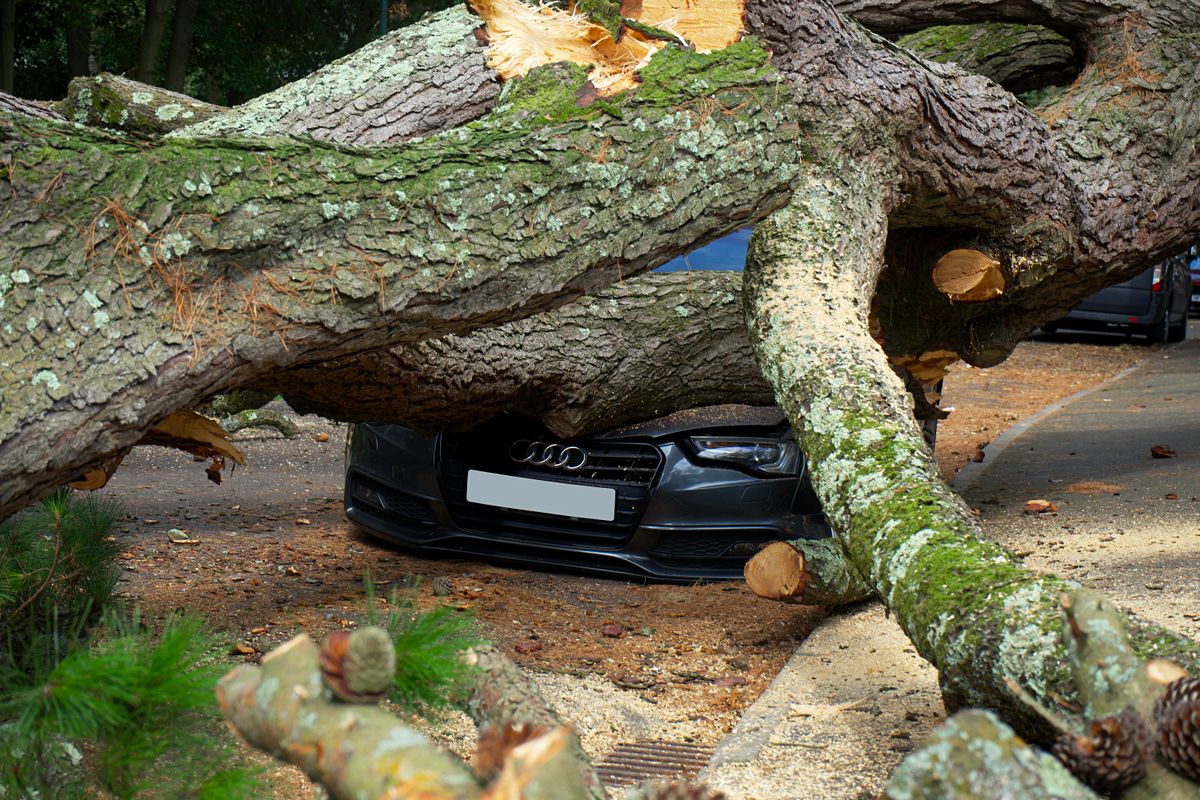
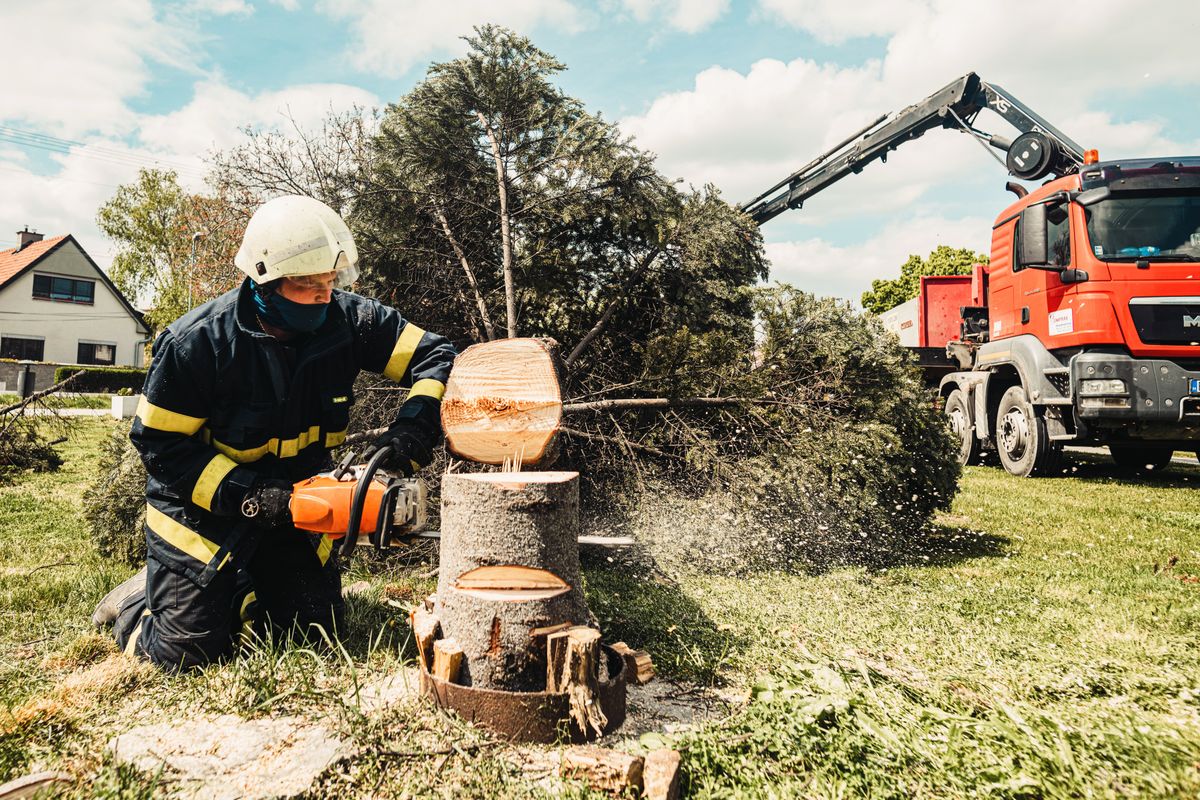
Example photos of storm-damage situations, not from a specific Dublin job.
Why Choose Dublin Tree Pros
We’re local to Dublin, fully licensed and insured, and committed to careful work and honest pricing. You’ll get a clear written estimate before we start and a clean property when we finish.
Emergency Tree Removal — Questions, Answered
Do you offer emergency tree services in Dublin, OH around the clock?
Yes. Emergency tree services in Dublin, OH are what this page is for: a tree on a house, garage, or car, a split trunk or a hanging limb over something it should not be over, or a road or driveway blocked after a storm. We answer around the clock, make the site safe first, then handle the removal, and we document the damage for your insurance claim as we go. For a planned removal that is not urgent, see our standard tree removal page.
A tree just fell on my house in Dublin — what should I do right now?
First, get everyone away from the tree and out from under any leaning or hanging limbs. Stay far clear of any downed power lines and treat them as live — call 911 and AEP Ohio first if lines are involved. Don’t try to cut the tree yourself; trees under tension can snap or kick back and cause serious injury. If it’s safe, take photos of the damage for your insurance. Then call us and we’ll prioritize getting a crew to you.
How fast can you actually get here?
Because we’re based in Dublin, we’re usually a short drive away — a real advantage over emergency crews dispatching from the south side of the metro. During a major storm, demand spikes across the whole area and we’re honest about that, but genuine emergencies are our top priority and we move as quickly as conditions allow. Call and we’ll give you a realistic ETA for your specific situation.
What happens during a storm-damage hazard assessment?
When we arrive, we first secure the area and look at the whole picture before touching anything: where the tree is under load and tension, whether it’s still partially attached or could shift, the distance to power lines, and the safest sequence to take it apart. Storm-damaged trees rarely come down the way a healthy felling would, so the assessment determines whether we rig and lower sections, use a crane, or stabilize first. We walk you through what we see and what it will take.
Does homeowners insurance cover emergency tree removal?
It often does — especially when a tree has struck a covered structure like your house, garage, or fence. Coverage, limits, and your deductible depend on your specific policy, so check with your insurer. We help by documenting the damage with photos and providing the paperwork describing the work, which is typically what an insurer asks for when you file a claim. We can’t tell you what your policy will pay, but we can give you the documentation to support the claim.
How do I file an insurance claim for tree damage?
In general: document everything with photos before anything is moved, contact your insurance company promptly to open a claim, keep any receipts for emergency work needed to prevent further damage, and don’t fully clean up until the insurer tells you it’s alright to. We provide photos and an itemized description of the emergency work, which slots into that process. Always follow your own insurer’s instructions — every policy and claims process is a little different.
How far back should I stay from a tree that is touching a power line?
AEP Ohio publishes a minimum of 10 feet from any power line for you and anything you are holding — ladders, poles, long tools — and says to stay completely away from a line that is down and never to move limbs or debris within 10 feet of a line. Treat a downed conductor as needing far more room than that, because energy can travel through the ground around it. Every line is live until the utility says otherwise: one that is not arcing can still be energized, and one that looks dead can re-energize without warning. The tree itself conducts once it is in contact, so do not walk in for a better photo. If a line has fallen on a vehicle you are in, stay in it and call 911. Call 911 and AEP Ohio; trees on primary conductors are cleared by qualified line-clearance crews, and the utility has to release the site before any tree company can work on it. We coordinate that handoff.
Do I need to report an emergency tree removal to the City of Dublin?
Yes, and almost nobody mentions this. Dublin issues the tree removal permit without a formal application when a tree is an immediate danger, so the removal itself does not wait — but the responsible party must report the action to the Planning Director or designee within 48 hours. If the tree was protected or stood in a no-disturb zone, ask about replacement-tree obligations while you are reporting it. We document what was removed and when, which is exactly what that report and an insurance claim both need.
Should I put a tarp on the roof or move the tree myself before you arrive?
Tarping is worth doing only if you can do it from inside the attic or without climbing onto a roof that has a tree resting on it — a loaded roof structure can give way, and a wet roof next to a storm-damaged tree is not a place to be. Do not cut or drag anything to clear access either; a fallen tree is usually holding tension somewhere, and relieving it in the wrong order is how limbs spring. Insurers generally expect you to prevent further damage where you reasonably can and to keep receipts for doing it, but not to put yourself in danger. Photograph first, protect what is safe to protect from the ground or indoors, and leave the rest to the crew.
What does emergency tree removal cost?
Emergency and after-hours work costs more than a scheduled job because of the urgency, added risk, and difficult conditions — a tree under tension on a structure is far more involved than a routine removal. We give you a clear price before we start whenever the situation safely allows, and we’ll never start cutting without you understanding the scope.
Is emergency tree removal the same as storm cleanup?
Related but not identical. Emergency tree removal is the urgent, often after-hours work when a tree is on a structure, blocking your only exit, or under dangerous tension. Broader storm cleanup can include clearing debris, hanging limbs, and non-urgent wind damage once the immediate hazard is gone. If you’re not sure which you need, call — we’ll tell you honestly whether it’s an emergency dispatch or a next-day scheduled job.
Our Other Tree Services
Serving Muirfield Village, Tartan Fields, Jerome Village, Ballantrae and all of Dublin, Ohio.
Helpful Guides
Answers to the questions we hear most about emergency tree removal — or browse all our tree care guides.
Tree Emergency in Dublin? Call Now — We Answer 24/7.
Fast, friendly, no-obligation quotes for homeowners in Dublin, Ohio.